
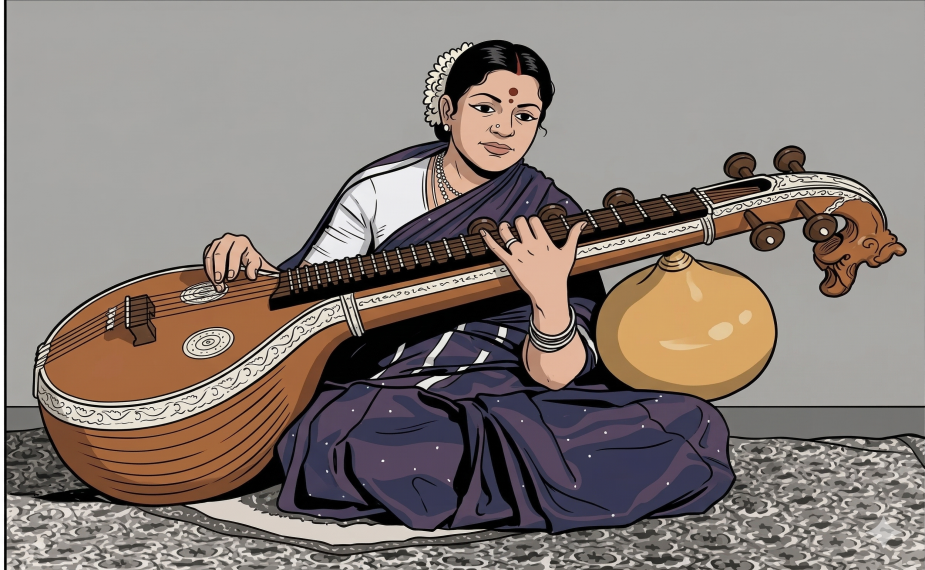
The Nightingale Visits IIT Madras
Courtesy: Glass Panels / Heritage Centre, IIT Madras.
Article by: Prof. Ajit Kumar Kolar, Retired faculty, and creative force behind Heritage Centre.
Ms. M. S. Subbulakshmi's historic association with IITM.
Ms. M. S. Subbulakshmi's historic association with IITM.
IIT Madras is well known for its academic accomplishments. Besides, residents of our beautiful campus have been fortunate enough to enjoy a cultural milieu of music, dance, arts, and literature, of different kinds. In particular, music of different kinds and changing trends, ranging from classical Carnatic and Hindustani, through Folk and all X-woods (Kollywood, Bollywood, Tollywood, Mollywood, Sandalwood, etc.) to Western pop, rock, blues, jazz, fusion, and classical too, has been at the core of this cultural milieu.
The more popular and larger Open Air Theatre (OAT) has been the venue of and witness to the changing tastes and genres in music for all batches of students and at least three generations of faculty members, staff, and others on the campus. Complementing this musical environment, sports and occasional theatre shows contributed to lively entertainment and all-round development of the audience. OAT continues to be a unique venue where legends of music perform, a few of them several times. The long list of legendary performers at our OAT includes Pandit Ravishankar (Hindustani Sitar), Pandit Hariprasad Chaurasia (Hindustani Flute), Pandit Shivkumar Sharma (Hindustani Santoor), Ustad Amjad Ali Khan (Hindustani Sarod), Ustad Zakir Hussain (Hindustani Tabla), Ustad Bismillah Khan (Hindustani Shehnai), Pandit Jasraj (Hindustani Vocal), Vidwan Balamurali Krishna (Carnatic Vocal), Vidwan Chittibabu (Carnatic Veena), Vidwan Lalgudi Jayaraman (Carnatic Violin), Vidwan T. N. Krishna (Carnatic Violin), and the one and only Vidushi M. S. Subbulakshmi Amma (Carnatic Vocal), the Nightingale of India.
I had listened to MS Amma a few times on All India Radio before I joined IITM in 1971, and a couple of times live in Madras later during the 1970s. But never did I imagine that I would someday have to organise her recital in our own campus, the first and the only time she performed for us! This happened in the early 1990s when I was the Cultural Advisor. The credit for this should go to Krishna, our cultural secretary that year.
As is well known, IITM used to have Inter-Collegiate cultural competitions in what was then called the Literary and Cultural Week, organised annually by the Students’ Gymkhana in January and usually with participation restricted to students of colleges in the city. In February 1974, this Cultural Week underwent a huge transformation and took a new avatar under the name “Mardi Gras” (MG), with the introduction of professional shows in a big way!
The preparations for Mardi Gras began the day student cultural secretaries were elected, very early in the academic year, or even earlier, i.e., late in the previous academic year, so that enough time would be available for planning the professional programmes and soliciting sponsors for the same. This really took a big jump once the globalisation of our economy started via the Liberalisation, Privatisation, Globalisation or LPG policy of the Government of India, which was announced in 1991.
The budget for the festival kept on climbing higher and higher year after year. Sometimes it was driven by a feeling of competition between one set of Cultural Secretaries and their immediate successors. The new organising committee always wanted to ‘best’ the previous organising committees, all in good intentions and, of course, in terms of the quality and popularity of the professional artists. Big multinational and national companies competed to sponsor the MG professional shows. In this scenario, the selection of Carnatic classical professional artists seemed to be less important when compared with attracting Hindustani classical artists. Globally famous artists were of a very high calibre without doubt, and had a much greater crowd-pulling capacity and fan following.
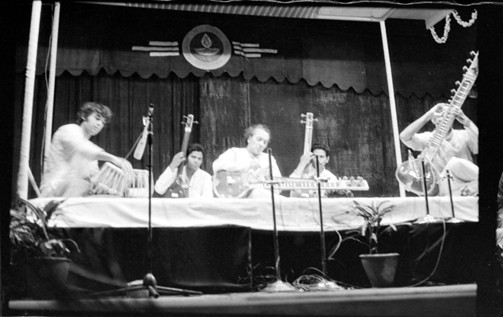
| A classical music performance by Pandit Ravishankar, Shri Ananda Shankar, and Ustad Zakir Hussain, at the Open Air Theatre during Mardi Gras, 1983. |
In such a fluid cultural setting, our then Student Cultural Secretary, Krishna, came to me one day and suggested we should get M. S. Subbulakshmi Amma for an MG opening day programme. I was thrilled that an artist of such eminence and of whose music I had only sweet memories, a celebrity of this class, could be there for the inaugural programme! Even as I jumped at the suggestion, I also expressed some reservations about the possible audience numbers and response, and more importantly, whether she would agree to perform in such a student-oriented and student-organised festival. At the back of my mind, there were two questions, one about a possible huge fee and the other about a suitable sponsor who would fund such a Carnatic classical programme in the OAT during MG.
Krishna assured me that the chances of MS Amma accepting our invitation were high, given the fact that he personally knew MS Amma’s secretary, through whom we could try. This made me a bit more hopeful, and we started serious negotiations. After a few hits and misses, I was very happy and excited when Krishna informed me that he had an ‘in principle’ confirmation of MS Amma’s consent to sing! We were then asked to visit her home to have a personal discussion about the details of the programme. I was overjoyed that a musically lay person like me, from a small town in Karnataka, had been blessed with this great opportunity to meet the most famous musician in the classical music firmament of the country and invite her to a performance in my alma mater, that too for the first time, and, as it turned out later, for the only time in the history of IITM!
MS Amma and her esteemed husband, Mr. Sadasivam lived in a modest house almost opposite the Valluvar Kottam, on Valluvar Kottam Road. With nervous anticipation of meeting the legend in flesh and blood and seeking her blessings, we went to their house. We were welcomed by Krishna’s friend and MS Amma’s secretary in the open foreground of the house, and some time late, Mr. Sadasivam came out to meet us.
We offered our respects, and he asked us to take our seats. He had all the features of a man in control and a no-nonsense approach to life. But, there was no sight of MS Amma! After he enquired about the date of the performance which was the first day of the festival during Pongal time (around 11th to 15th January), he unilaterally mentioned the duration of the recital, reeled off the keertanaigal (songs) MS Amma would sing and their order, the remuneration amount, and the names of two organisations to whom the remuneration was to be paid in the form of cheques right on the stage at the conclusion of the recital. The organisations were the Juvenile Diabetes Society and the Amar Seva Sangham.
Only then did I realise that the entire remuneration was to be paid as the couple’s donation to other needy organisations, and not a single rupee to themselves! He made one concession, though, that MS Amma would sing one song of the students’ choice! There was still no sight of MS Amma, to whom I wanted to offer my respects. Once the terms and conditions of the recital were dictated to us, he offered us kashaayam, a bitter but healthy home-made drink, saying he does not offer coffee, but only kashaayam! No choice either! Again, I was eagerly waiting for MS Amma to give her darshan, but no, we were served kashaayam by a house help. I was getting anxious to see MS Amma at least from a distance, but Mr. Sadasivam announced that the meeting was over and we could leave. I was looking pleadingly at Krishna to materialise a darshan of the legend, but he gave a helpless look, and we left, without a much-awaited and wished-for personal meeting with MS Amma. We saw her only on the day of the performance when she arrived at the OAT in her own car!
As the preparations for MG were going on in full swing, a few weeks before the actual performance, we got a call informing us that MS Amma was invited to perform at the Rajiv Gandhi Foundation around the same date as was earlier fixed for our MG! While we were initially shocked, we were greatly relieved that she was ready to sing at any later date of our choice! After intense discussions in our organising committee, we decided to postpone MG by about a week, and hit upon the idea of using the Republic Day holiday to cut down on ‘classes suspended’ for MG, and worked out the dates accordingly. This practice, I understand, continued for many years.
On the day of the performance, a big day for IITians, MS Amma and Mr. Sadasivam arrived at the OAT in their own car; they were guided to the backstage hall for last-minute rehearsal and preparation. One student helped MS Amma by carrying her tanpura with a sense of respectful duty. I could see that, as much as I was, Krishna was visibly thrilled that his efforts were bearing fruit and MS Amma was actually in OAT in person, ready to sing! The last time she and Mr. Sadasivam were at the OAT was most probably in 1967 during the Fourth Convocation when Sri C. Rajagopalachari was the chief guest.
There was a great surprise waiting for us when the founder of the Amar Seva Sangham, Sri Ramakrishnan of Ayikudi, one of the recipients of that day’s donation, arrived in a car right onto the OAT stage. I opened the front door of the vehicle, wished him a warm welcome, and extended my hand for a handshake, only to see his smiling face just looking up at me. I suddenly found two people in his accompanying group come up to him, bodily lift him, and place him in a wheelchair! He was paralysed from the neck down due to an unfortunate accident many years before, and all he could do was to greet people present there with a happy smiling face! He was being honoured for the tremendous social service he was doing for poor and disabled people in interior Tamil Nadu. I was left truly speechless and embarrassed for extending my hand to him for a handshake! I was even more pleasantly surprised when, after a few months, I received a letter from him informing me that a room had been added to an existing building in his village using the money that was donated to his organisation! He asked me to convey his thanks to the students of IITM for the gesture. He was duty, humility and gratitude personified in the face of personal adversity!
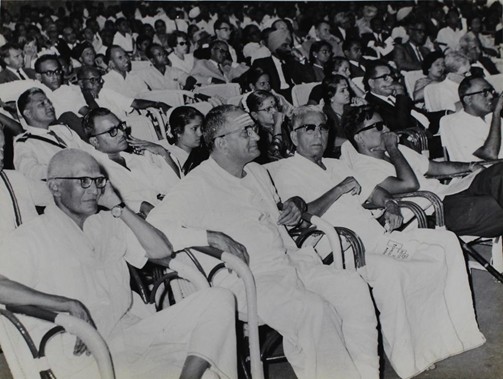
| An image captured during IIT Madras’s Fourth Convocation in 1967 featuring Ms. M. S. Subbulakshmi (second row, third from left) and her husband Mr. Kalki Sadasivam (front row, second from left). |
After a divine concert, admired by a sizeable audience, during which her Nightingale-like voice permeated across and perhaps beyond the OAT, the humble and graceful persona that MS Amma was merged into the multifarious nature and natural sounds of flora and fauna on our campus. Our Dean handed over the cheques to the two organisations as desired by Mr. Sadasivam. He was sitting in the first row in the OAT in front of the stage, and he did not come on to the stage to present the donation cheque himself, but instead chose to give our Dean the chance to do so!
Krishna, Members of the MG Steering Committee, I, and some others of IITM, who experienced that magical night there that day, did not realise at that time that we were witnesses to institutional history in the making. MS Amma, the musical legend, never performed again on our campus. All of us, including Krishna and me, were truly blessed to have been an integral part of that historic Classical Music Night. Naturally, I experienced the honour of listening to her a few more times in Madras. My final encounter with the Nightingale was on 11th December 2004. On reading about her demise in The Hindu, just as the annual year-end Madras Music Season unfolded, I rushed to her residence in Kotturpuram. I was among the earliest visitors. She was lying in peace in a casket. The immediate family members were waiting for VIP visitors. I touched her feet in one final expression of respect and, on my own behalf and on behalf of IITM, prayed for her eternal peace. I felt a sense of completion and fulfilment. The classical music world was robbed of its true gem, the Bharata Ratna, forever! But, our own OAT will forever hold and cherish the sacred memory of her graceful personality and the fragrance of her sonorous, ethereal voice and singing.
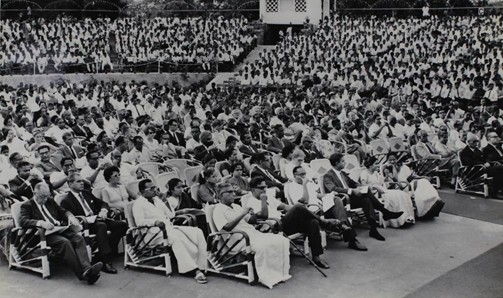
| Third from left in the second row is the singer, Ms. M. S. Subbulakshmi |
Ajit Kumar Kolar
A retired faculty member of the Department of Mechanical Engineering at IIT Madras, was the first Faculty-in-Charge of the Heritage Centre and served as the Institute’s Cultural Advisor from 1992 to 1996. In addition to his academic and administrative contributions, he is remembered for his abiding interest in classical music.