
EVOLUTION OF OAT MOVIE SCREENINGS
Courtesy: Glass Panels / Heritage Centre, IIT Madras
When you mention the Open Air Theatre (OAT), it stirs up so many nostalgic thoughts in the mind, even after over half a century since graduating from IIT Madras. While dementia might not be a strange companion for most of my aged contemporaries in our late seventies, the Saturday night movies at the OAT will always remain an enduring memory. And what a memory! One that is still filled with inexplicable pleasure, filled with movies (mostly from Hollywood), stars, storylines, and scenes. The expectation of every Saturday made this an eagerly anticipated event, a chance to let off steam, so to speak.
I joined the B.Tech. course in July 1964, and the first years were all “herded” into Godavari Hostel to protect us from ragging, though ironically it made it easier for seniors to rag many of us together simultaneously!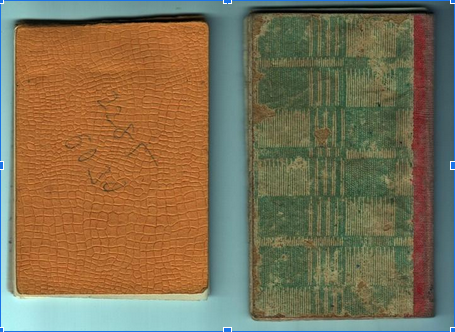
| Diaries in which I maintained a list of movies screened at the Open Air Theatre (OAT) |
There were no hostel security guards then as at present. Going to the OAT also meant that we went in small groups rather than as individuals. But the dirt-cheap rates of being charged just 25 paise per movie or Rs 1 per month (added to our mess bill) were heaven-sent for the wholesome entertainment every Saturday after a gruelling academic week. Being just out of our teens then and getting into adolescence was a heady experience, and suddenly exposed to the wide world of movies. Most of us would have hardly seen many movies in our pre-IIT days, and that was often accompanied by our parents. Our monthly mess bills used to be just around Rs 60-90 for vegetarians over our 5-year period and around Rs 80-120 for non-vegetarians; and a haircut at the then Shopping Centre (now completely renovated with a shopping plaza) was then just a rupee to a rupee and a half.
The Saturday mess dinner (each hostel then had its own mess) would normally consist of simple fare like fruits (usually oranges or bananas) and curd rice with pickles as the main course, supplemented with cutlets for the vegetarians and eggs for the non-vegetarians.This was to give the mess staff a break from full meal preparation. So one would gobble it all up soon after 7 pm and rush to the OAT. Some bold and naughty types would save the orange peels for the missile-throwing-in-the-dark exercise at OAT. Later, oranges were off the dinner menu.
The attire for the OAT movies was most casual and even irreverent, with shorts or dhotis/lungis, and just home-use t-shirts, and of course, just bathroom slippers. Since the initial screen format was just 16 mm, there was always a rush to grab vantage seats with a straight view rather than the latecomers who were forced to see the movie from the corner of their eyes. The unforgiving concrete gallery seats made having your own cushion a real comfort for aching backs and bottoms! If memory serves me right, the overall numbers would have created a 120-degree audience huddled around the small 16 mm screen view.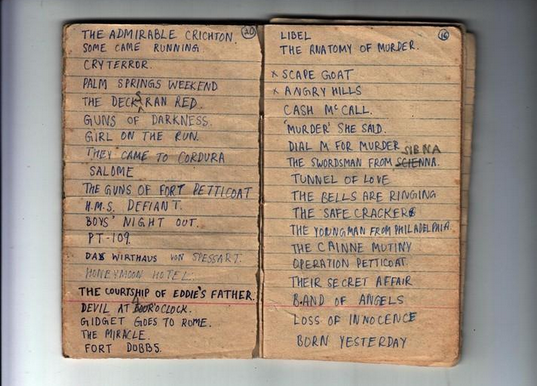
| An expert from my diary featuring movies such as Dial M For Murder and Honeymoon Hotel. |
It was only around 1967 that we went in for a 35 mm projection facility. This equipment was all hired from local audio-visual equipment, but was subject to frequent interruptions, sound problems, etc. Yet, it totally changed the whole dynamics of watching and enjoying movies on a large screen (even though a makeshift cloth screen). Since it was a singleprojector-only setup, inevitable reel changes made for some unintended breaks, leading to joyful wisecracks, loud comments, and even mischievous pranks. Even after we got the big screen projection, the students were confined to seating in the concrete galleries, while the central well of the OAT was reserved for faculty and staff members, who usually brought their own folding chairs.
During the rainy season, it was the “done” thing to continue watching the movie, since, anyway, the projector and the projectionist were protected from getting drenched. Smart alecs with umbrellas were booed to close their umbrellas or move to the rear of the galleries.
Our 1969 batch started classes on 1 July 1964. Immediately, we were very fortunate to be witnesses to the first-ever Convocation of IIT Madras held on 11 July 1964, with the then President of India, Dr. S. Radhakrishnan, delivering the Convocation Address. Our first movie at the OAT was on 18 July 1964. All in all, it was a real heady feeling for us to become an integral part of the fabled story that was, and more so now, a revered and elite educational institution of the country.
As I recall, our first OAT movie was No Room for Wild Animals, a documentary film produced by the brothers Michael and Bernhard Grzimek. It was a movie made to protest the indiscriminate slaughter of Africa’s wild animals.
Anyway, we all thought, Wow! What a privileged place to be in to pursue our engineering education, and also enjoy whatever else the campus has to offer us for the next 5 years at least. 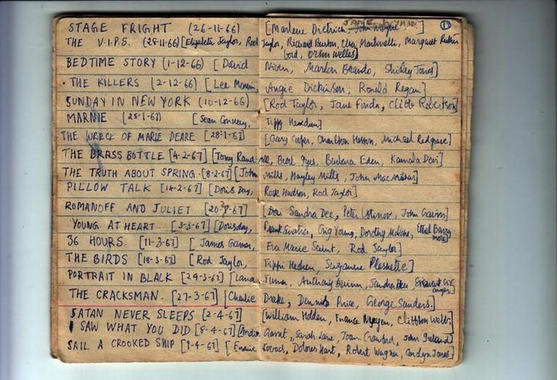
| And the list goes on! |
Being an ardent movie buff myself, I kept a detailed record of all the movies shown at the OAT over my 5- year stay. I kept them all recorded in my handwriting in a diary, which I still have. It was only much later that I transferred all these details into computer files. I then noted down the names of all the actors involved, the producer and director, and also the music director and other key people involved. This remains one of the proudest possessions from my IIT days.
On average, about 45 movies were screened every year, making it around 200 movies during my 5 years. These sheer numbers would not have been seen if we had just stayed home with our parents. These movies covered all genres and types—westerns, crime and suspense thrillers, romantic comedies, war-related and courtroom dramas as well. But mostly made in Hollywood. I will briefly dwell elsewhere on other language movies.
For those of us who were not strong in the English language, these movies were a great learning ground. They were our window to the outside world, though knowingly artificial. Picking up the English language, understanding American accents, having armchair travels to exotic foreign locales, watching famous film stars, et al.—all left indelible impressions on our young minds.
But one bottom line was that, irrespective of any forthcoming periodical tests (our biggest bugbear then!) or any exams, attending the OAT movie was taken for granted. It had become an important and inevitable part of our IITM lives.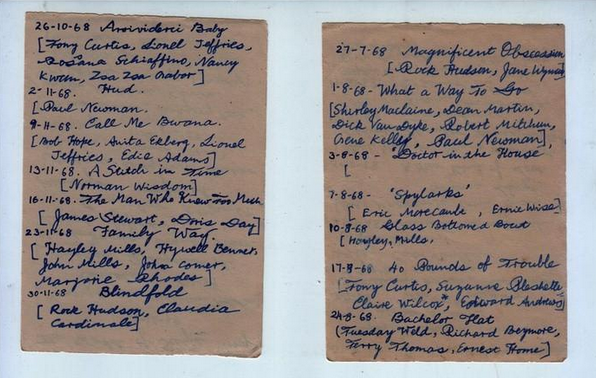
| More pages from the diary |
There were a few really memorable movies that I can still recall vividly, like Zorba the Greek, What a Way to Go, Boeing Boeing, Operation Petticoat, and Charade, amongst many others. Of course, each of us had our own favourites.
While movies at OAT have been the focus of this article, one cannot ignore the overall movie scene in Madras itself. The city’s cinemas featured memorable movies like My Fair Lady, The Sound of Music, Wait Until Dark, Hatari, The Guns of Navarone, Dr. Zhivago, various James Bond films, Carry On series films franchise, Cleopatra, Ice Station Zebra and other Alistair Maclean book-based films, The Good, the Bad and the Ugly and other spaghetti Westerns such as The Graduate, and Butch Cassidy and the Sundance Kid.
I recall one particularly memorable episode in 1965 or 1966 when the first James Bond movie, Dr. No was released at the Rajkumari Theatre in T. Nagar. Though still not qualifying be a real adult then, many clamoured to see Ursula Andress in the briefest of bikinis. I was told that the ticketing queues were a kilometre long, and tickets were being sold in the black market at around Rs 100-150 (against the normal of around Rs 3-5).
I understand that quite a few were turned away for not being adults, but many still managed to sneak through to see it.
One may wonder why these could not be screened at OAT. Besides their tremendous box-office popularity, concerned distributors were not willing to make available such movies for screenings for non-profit institutions like clubs and educational institutions. I was told that such movie charges paid by IITM then were just Rs 140 for a black and white movie and Rs 160 for a colour movie for a single screening, irrespective of their audience numbers. Later, there were special arrangements with Mumbai film distributors to give us movies at decent rates, which were also then shared with Guindy Engineering College, which screened the same movie on Sunday.
Of course, true movie buffs amongst us used to patronize the city theatres and see these movies, especially at the Safire tri-theatre complex, Anand, Casino and Elphinstone Cinemas, as also Minerva (in the Parry’s Corner area with cane chair seating).
That period also saw blockbuster Tamil films released in the city. Some of them were: Kadhalikka Neramillai, Vennira Aadai, Thillana Mohanambal, Enga Veettu Pillai, Pasamalar, Navarathri, Uyarntha Manithan, Parthal Pasi Theerum, Server Sundaram, Deiva Magan, Aayirathil Oruvan, Anbe Vaa, and Adimai Penn. Most of these films were dominated by stars like Sivaji Ganesan and M. G. Ramachandran.
A notable Hindi movie released in Chennai was Raj Kapoor’s Sangam in 1964 and shown at the Shanthi theatre. But the Hindi movie releases suffered later in Madras due to the local anti-Hindi agitation in early 1965. Non-English movies at OAT were then very few and far between. Notable ones were Kashmir Ki Kali (Sharmila Tagore’s debut film) and the Malayalam film Chemmeen, which won the National Film Award for Best Film in 1965.
A significant milestone in OAT’s movie history then was the screening of the first ever Tamil film in 1968 on Tamil New Year Day with the September 1967 released movie Ninaivil Nindraval starring K. R. Vijaya and Nagesh amongst others. We did have a few other films in Kannada, Malayalam, and Telugu during special occasions. However, I somehow failed to keep records of them.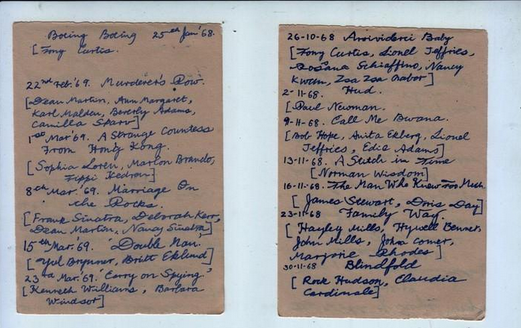
| How many of these films have you watched? |
One great boon for English movie goers was the unique Safire Blue Diamond Theatre, which had continuous shows at just Rs 2.50 per ticket, where one could go in and out at any time during the movie screening. For those of us with no family or relatives’ homes in Chennai, this was the best thing to do on a Sunday evening. The nearby Woodland’s Drive-In Restaurant or Buhari, or various Chinese restaurants on Mount Road were the regular food jaunts before getting back to the Monday academic grind.
Another memorable feature of our IIT days was the prevalence of “travelling/tent/touring cinemas” just outside our hostel environs in Velachery and Taramani, which were real villages then! These were just thatched-roof temporary structures with lower-class floor seating on beach sand and on benches for us higher-paying patrons. They usually featured Tamil double-feature movies. This was an apt outlet for those nights before public holidays coming mid-week.
Many of my mates tell me that it was watching these movies that helped them to pick up the Tamil lingo in all its myriad colours!
During our time, there was also an instance of a Tamil film shooting on campus around the Gajendra Circle featuring (late) Jaishankar. But I think the commotion it created with students gawking at them and bunking classes put an end to such permission given by the IITM administration.
One memorable prank played by the Film Secretary on all of us during 1967, when a special movie, What a Way to Go, was announced for the first of April. Only after half an hour or so, there was a slide message to say it was April Fool's Day! As it finally happened, this 1964 movie was shown to us later in 1968.
All said and done, the movies at OAT were an important and unforgettable part of our IITM campus life, with fond memories even today. Long live the OAT!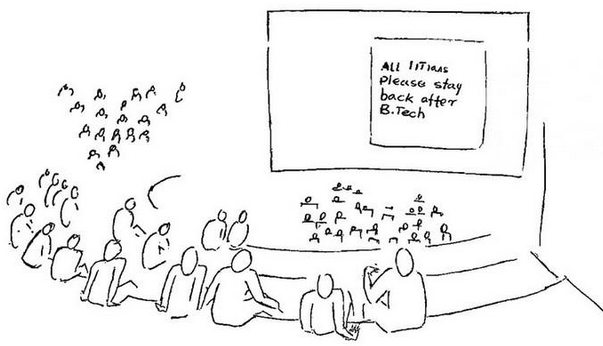
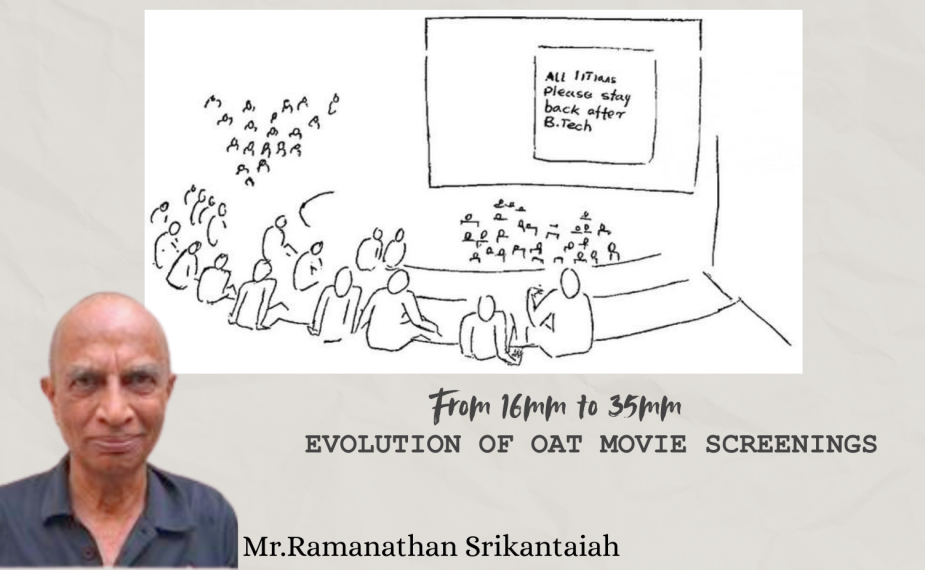
| An illustration of a Film Club movie screening at the Open Air Theatre, published in the September 1983 issue of Campastimes. The illustration was made by Mr. Joseph Joy. |
Editor’s Note: During intermissions, announcement slides would appear on the Open Air Theatre screen. The cartoon below was inspired by messages such as “All team captains stay back after the movie to meet the Sports Secretary.” It also lightly nods to a well?known trend from that era, when many B.Tech. graduates chose to pursue opportunities in the US soon after completing their studies.
Ramanathan Srikantaiah earned his B.Tech (1969) and M.Tech (1972) in Electrical Engineering from IIT Madras. He served at DRDO’s Aeronautical Development Establishment, Bangalore, until 1998, specializing in flight test instrumentation, telemetry, telecommand, and electronic system reliability. Post-retirement, he consulted on railway safety systems. His hobbies include philately, numismatics, photography, digital restoration, and culinary arts. Passionate about teaching Physics and Mathematics to young school students, he now resides in Bangalore. Srikantaiah wrote this article with supplementary inputs from his batchmates K. Sashi Rao and K. S. Loganathan.
Click here to read more articles from Glass Panels
Click here to read more articles from Glass Panels