
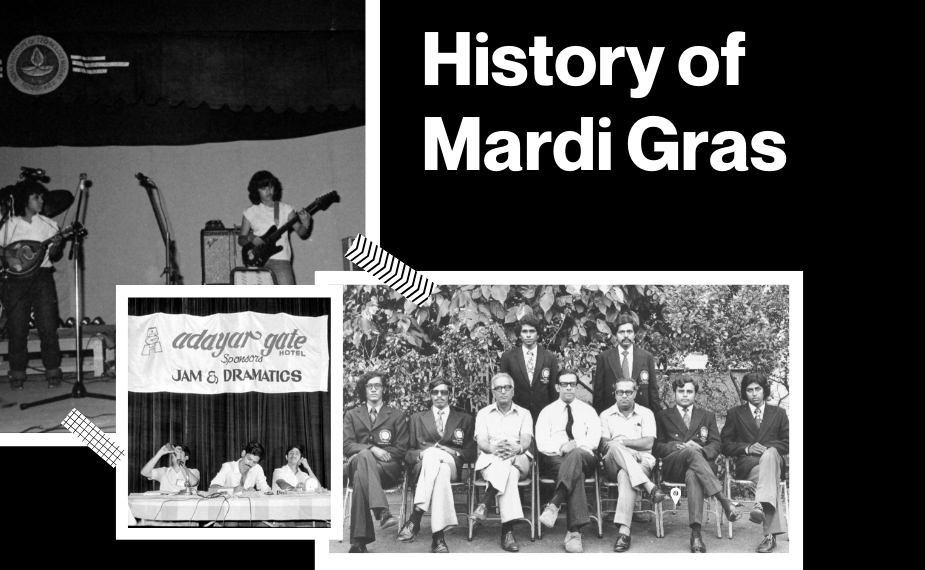
The History of Mardi Gras
A collective history by Keshav Gopinath, George (Johnnie) John, Ashok (Sant) Santhanam, (Kich) S. Krishnaswamy and M G (Bobo) Sriram and others.
Prologue
Prologue
Mardi Gras 1974 transformed the idea of a college festival, and was the defining moment for our class. In this document, we reconstruct for the reader some idea of the flavor and sounds of that year. Conceived as it was by the final (5th year) B.Tech class, it is worthwhile to recall the principal pre-occupations and rhythms of the IITM class of 1974. First, India was in the grasp of a closed economy with “import substitution” the watchword of the day. In practice, this meant a threadbare selection of consumer goods even if one had the money to purchase it. For the average 21 year old at IITM, it meant that a single copy of a current rock album brought back by one of our more fortunate classmates with connections abroad (Mathew Mathai comes to mind) would be diligently copied over to cassettes, and pored over repeatedly to sort out the more obscure lyrics. A bizarre side-effect of radio broadcast policies of the day was the regularity with which year-old radios, and “all-in ones” (later called boom boxes) would be reported “lost” to the police so as to avoid paying the dreaded broadcasting tax (intended to support the one medium-wave and one short-wave broadcast from All-India Radio) the following year. Finally, the tiny number of companies that came to campus to recruit meant that getting a job didn’t take up much of one’s time. Instead, much more time was spent on applying to numerous US universities in the hope that a scholarship would be forthcoming.
The make-up of our class greatly influenced all aspects of every day life at IITM. Given the geographic disparities in the results of the Joint Entrance Exam and the curmudgeonly reluctance to consider anything but one’s JEE rank, IIT Madras hosted a healthy contingent of Bombayites and Delhites who were convinced of the social superiority of their cities and regions in comparison to conservative, insular, Madras. This was most keenly felt in the disparity between their constructed narratives of exciting collegiate social life back home, and the wretched reality of our all-male class (well, Brinda did provide a singular disconfirmatory instance). At least they could console themselves that their exile was coming to a close, unlike the poor souls from the South.
The Mardi Gras story actually started a full year and a half earlier. In late 1972, several fourth years headed off to IIIT Kanpur to their cultural festival. At that time, IITM had an annual “Cultural Week,” which was held over an entire week during the evenings after classes with participation from a number of local colleges. That was our frame of reference for Kanpur’s efforts. As “Sant” recalls “ ... Our train ride had been two days of non stop fun, and I thought that it would all be downhill from there. Kanpur wasn’t exactly a bustling metropolis, and the IIT campus seemed to be out there in the middle of nowhere”. But the place was crawling with girls! Not locals either. These were college girls from Delhi, Bombay and Calcutta. Each one seemed to be better looking than the last, and having a good time. We barely noticed the other IIT teams (male-dominated like us). Life seemed completely upside down. These IITK guys, sitting in a campus in the middle of nowhere situated outside a one-horse town like Kanpur, were able to attract fantastic girls from all over the country for three days of concentrated fun while we had to make do with local girls from staid, conservative Madras who showed up only for a couple of hours each evening. There was clearly something wrong with this picture. Johnnie and I resolved that something had to be done.” Johnnie adds “Watching the sun rise after an all-night concert is my defining memory of that festival”.
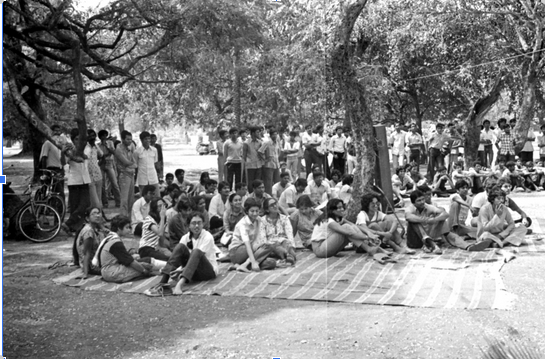 The team resolved that we had to do something. Sant suggested to “Nattu”, the 72-73 Cultural Secretary, that we try to copy Kanpur for our upcoming Cultural Week in January/February of 1973. Invitations went out, and one “out-station” college did participate, Jyoti Nivas of Bangalore. We learned the lesson that our extant week long format was not very friendly to visitors—they had to take a whole week away from classes and found themselves with times on their hands during the day while the hosts attended classes.
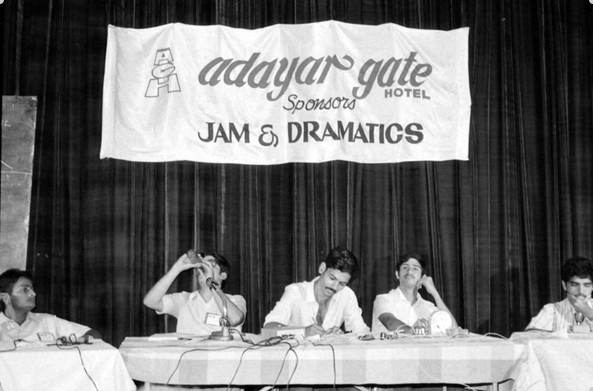 The stage was set when Sant campaigned in the early part of his final year (73-74) for Cultural Secretary on the plank that he would re-fashion Cultural Week into a three day festival with the explicit promise of out of town participants, especially from the more glamorous parts of the country. Johnnie, who was campaigning for Literary Secretary signed on to Sant’s plank.
The team resolved that we had to do something. Sant suggested to “Nattu”, the 72-73 Cultural Secretary, that we try to copy Kanpur for our upcoming Cultural Week in January/February of 1973. Invitations went out, and one “out-station” college did participate, Jyoti Nivas of Bangalore. We learned the lesson that our extant week long format was not very friendly to visitors—they had to take a whole week away from classes and found themselves with times on their hands during the day while the hosts attended classes.The stage was set when Sant campaigned in the early part of his final year (73-74) for Cultural Secretary on the plank that he would re-fashion Cultural Week into a three day festival with the explicit promise of out of town participants, especially from the more glamorous parts of the country. Johnnie, who was campaigning for Literary Secretary signed on to Sant’s plank. Sant recalls the campaign, “I campaigned on that platform. I met the elected representatives of each hostel, and my message was simple to all of them (except Sarayu, where I had to tweak it for obvious reasons). Vote for me, and if elected I will create a cultural festival that would attract girls from Bangalore, Bombay and Delhi to our campus. Back then the IIT Madras female student population was a total of 40 or so, out of a student body of about 1,200 UGs and 400 PGs – not exactly ideal. So my campaign promise addressed a felt need, and resonated with most of the electorate (except the guys in Krishna and Cauvery, (the post-graduate hostels), who seemed to have a hard time appreciating the inequity of the problem).
I won the election, and Johnnie got elected as well. “Kich” became Fine Arts Secretary. We were the three guys who would have to make the campaign promise a reality.”
Conception
Johnnie, Kich and Sant took the lead as the most immediately responsible people, but the entire Steering Committee was involved as was the Editor of the student paper, “Campastimes,” (M. G. “Bobo” Sriram).
First and foremost, the format had to change to make it convenient for out-of-towners to show up, which meant we would have to find three full days to hold the festival. In turn, this meant the Institute Director had to agree to declare Institute holidays for those days. We would also have to minimize time away from classes for our visitors and our own students. Keep in mind that no classes were cancelled fat IITM or the Inter-IIT Sports Festival, or even for Tamil Nadu state holidays. Nevertheless, we took our audacious proposal to Deputy Director Sampath. DD was a wonderful man with a heart of gold who truly loved IITM and its students. Much to our delight, he turned out to be a soft touch who readily agreed to cancel classes for a couple of days so we could hold the festival in late January/early February.
Second, we needed a name. Cultural Week no longer applied, and IIT Kanpur already had Cultural Festival. Besides, these were boring names. We wanted to draw people in. IIT Bombay had “Mood Indigo”, which had a nice ring to it. We needed something at least as good (and as pretentious). Simon and Garfunkel was hugely popular at the time, and Paul Simon had just released a Dixieland jazz-flavored tune called “Take Me to the Mardi Gras”. That was it. We decided to call our festival Mardi Gras, after the Mardi Gras festival of New Orleans, although one of our Catholic class-mates did observe that the Lent fasting period following Mardi Grads seemed absent in our planning. Oh well. It sounded good (and pretentious), evoked images of the popular Simon and connected with the jazz overtones of Mood Indigo. Perfect. Interestingly, no one in conservative, 1970s Madras ever objected to its vaguely “non-Indian” origins, despite this becoming a reason for dropping the label decades later.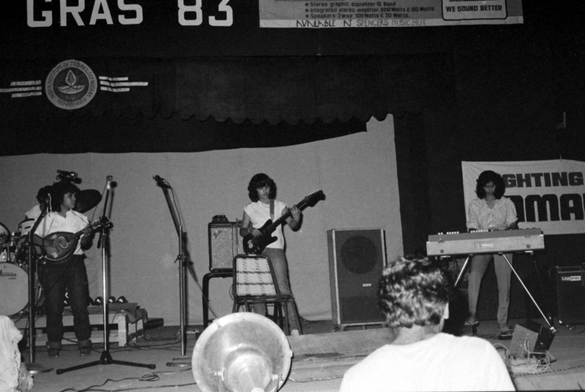 Third, we wanted to change the makeup of the individual events. The earlier incarnation consisted of debates, group discussions, quizzes held at the Central Lecture Theatre (CLT) and a variety entertainment competition held at the Open Air Theatre (OAT). The variety entertainment program included skits, western music, Indian popular music, western and Indian classical music and so forth, but our audience of 2,000 raucous students tended to drown out the classical music performances. Yet, the classical musicians were among the most talented of all, and they deserved to be heard. Sant I personally felt quite passionate about this, and decided to eliminate variety entertainment in favor of focused events. This allowed us to move classical music performances to CLT, so attendance would be limited to those who were interested, which gave these performers the hearing they deserved.
Third, we wanted to change the makeup of the individual events. The earlier incarnation consisted of debates, group discussions, quizzes held at the Central Lecture Theatre (CLT) and a variety entertainment competition held at the Open Air Theatre (OAT). The variety entertainment program included skits, western music, Indian popular music, western and Indian classical music and so forth, but our audience of 2,000 raucous students tended to drown out the classical music performances. Yet, the classical musicians were among the most talented of all, and they deserved to be heard. Sant I personally felt quite passionate about this, and decided to eliminate variety entertainment in favor of focused events. This allowed us to move classical music performances to CLT, so attendance would be limited to those who were interested, which gave these performers the hearing they deserved. Fourth, we needed to market the event. Ringing up people we knew at other Madras colleges had to go. It wouldn’t work. We would have to come up with something better. At that time, a large fraction of our class was busy with applications to American graduate schools. We were impressed by the variety and appeal of the brochures they sent us in those lovely, fat envelopes. Particularly interesting was the tie-in between iconic aspects of each school and the graphics used; C.W. Post School of Long Island University used a particularly “groovy” graphic design, which inspired Kich, our master artist, to design an invitation card that was declared both “groovy and psychedelic” by all concerned. With said masterpiece, we would target all the groovy, beautiful people of Bombay and Delhi (who said Madras was staid?). We spent altogether too much money to get the best of the generally awful card-stock available locally at that time. More prosaically, we patterned the information in our brochure and invitation along the same lines of the American universities as well– information about IIT Madras, about the city of Madras, the weather at that time of year, directions from the station, etc.
Fifth, we needed support from the administration since our ambitions were higher than anything IIT Madras had held before. As with the Institute holidays declared by DD Sampath, the gentlemen in charge of the Institute were amazingly supportive. Keshav Gopinath recalls “.... I don't believe that the question of a budget ever came up. We asked Professor NVC Swamy for whatever funds we needed and he paid up. Interestingly, our biggest amount was spent was on the T-Shirts. We had 3 designs. One featuring a sun, another a cartoon character lying on his back with large feet facing you, but unfortunately the specifics of the third slips my mind. Kich and Pooviah drew them. I took the drawings over to a T Shirt guy in some corner somewhere and he got the shirts and printed them up. I told NVC how much it cost and he paid me. On an unrelated note, I remember splurging on autos to go to WCC, Ethiraj, Stella Maris and Cultural Academy and was always reimbursed. ”
Keshav’s personal deliveries of the invitations were no accident. At that time, the vast majority of Madras colleges were single-sex, with Madras Christian College a notable exception. As such, we had no problem with getting acceptances from the men’s colleges, but personal invites were the order of the day at the women’s colleges.
Kechav recalls “ … This was the first time for Ethiraj. I had to convince the Principal (stern matron no doubt) to make it happen. My clearest memory is that of her office with spring loaded half-doors like a Western saloon in a cowboy movie, except with an Indian touch (a peon outside).
The planning for the festival in late 1973 coincided with the strike by hostel staff, which was quite traumatic, but which fortunately did not put our planning back very much, In fact, some invitations were aided by the week-long holiday declared immediately after the strike ended. Again, Keshav: “.. During the holiday after the strike, Johnnie and I went to Conoor to my parents. As long as we were there, we decided to invite Providence College, (a women’s college nearby) in person. We borrowed my Dad’s car to impress them, and it turned out to be quite a drive with hairpin bends all the way to Providence. Rather to our surprise, they accepted despite it being their first time. Many of you will remember their student President Usha Nayar (whose name Bobo unfortunately misspelled on the flyer).”
The Event Itself
Despite the promise of a large number of teams from various cities, and the acceptances from many women’s colleges, we were never quite certain about how many would show until each team arrived at Madras Central. IIT vans had been arranged for, and we brought our guests to campus, where they were put up at various hostels.
Again, Keshav: “… Sant and I had the duty to pick up the Providence girls. It was an early train and a cool winter morning that made it quite special.”
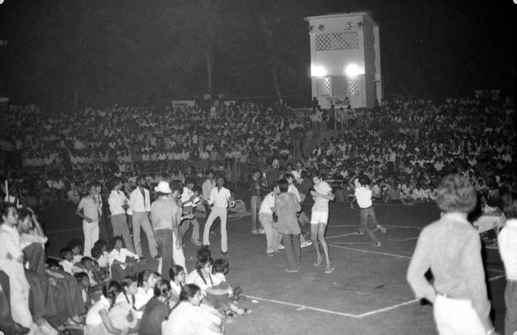 Our cunning schemes notwithstanding, we were quite lucky. Mardi Gras succeeded in every respect. The crowds were phenomenal. Almost anyone and everyone was there, whether they were a high school kid or a college student. It was the first festival of this scale and scope held in Madras and everyone wanted to be a part of it - whether a participant or attendee. One constantly bumped into people one knew from outside, even those who were just curious. Naively, we had not planned for crowd control ion any serious way. Bobo recalls “… The most rowdy moments came with OAT attendees throwing paper aeroplanes made out of those decorated note-paper sheets we had handed out to help people jot names and addresses down”.
Our cunning schemes notwithstanding, we were quite lucky. Mardi Gras succeeded in every respect. The crowds were phenomenal. Almost anyone and everyone was there, whether they were a high school kid or a college student. It was the first festival of this scale and scope held in Madras and everyone wanted to be a part of it - whether a participant or attendee. One constantly bumped into people one knew from outside, even those who were just curious. Naively, we had not planned for crowd control ion any serious way. Bobo recalls “… The most rowdy moments came with OAT attendees throwing paper aeroplanes made out of those decorated note-paper sheets we had handed out to help people jot names and addresses down”. In their first edition of a long-repeated tradition,, Madras Christian College did two memorable things on the last night of the festival. They were the last Western pop music team to go on, and they were extraordinarily LATE with endless sound checks and what not, which made a restless OAT crowd somewhat short-tempered. But, they brought down the house. As Johnnie recalls “… the hangers-on, the musicians, the organizers, the audience were all awed. The strains of “Jesus Christ Superstar” resonating in the OAT (which was a great amphitheater to begin with) hushed everyone. When they said goodnight, you felt that you had been privileged to have been a part of it”. Our out of town guests confessed that the MCC set beat anything they had heard back home.
And so, it can be said that Sant, Johnnie and Kich kept their campaign promises. IITM was no longer a socially conservative backwater locale in the south of the country (in our eyes, at least). Girls from Miranda House, and Lady Shriram had traveled all the way from Delhi; there were waves of talented, bright women (and men) from local colleges on our campus for three straight days. And, best of all, everyone behaved beautifully. And we started something that ran for decades. So, to all the guys in our class, to all the people who accepted our groovy invitations, to all the attendees who transformed the campus for three shining days, and most of all to our faculty and administrators who made it possible, thank you after all these years.
Picture Courtesy: Heritage Centre