
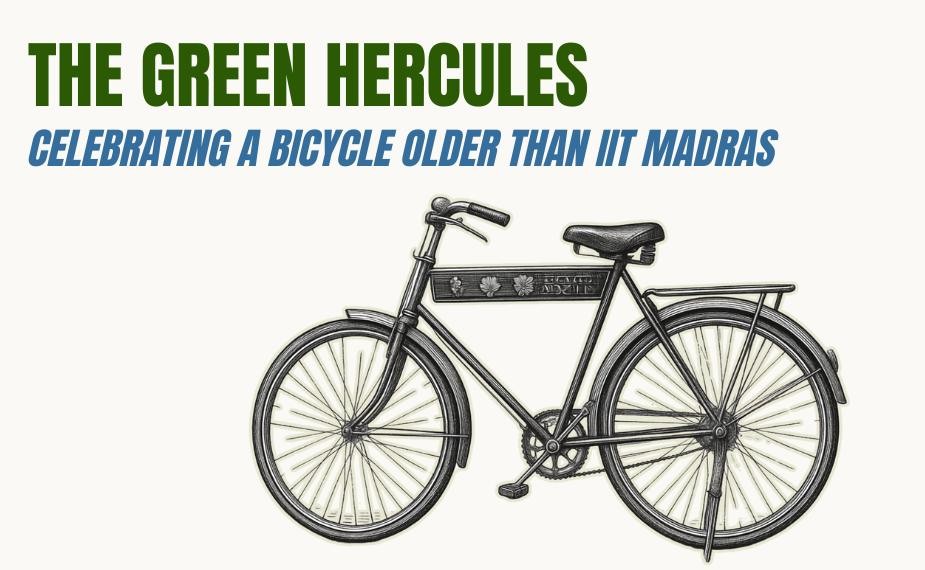
THE GREEN HERCULES CELEBRATING A BICYCLE OLDER THAN IIT MADRAS
Courtesy: Glass Panels / Heritage Centre, IIT Madras.
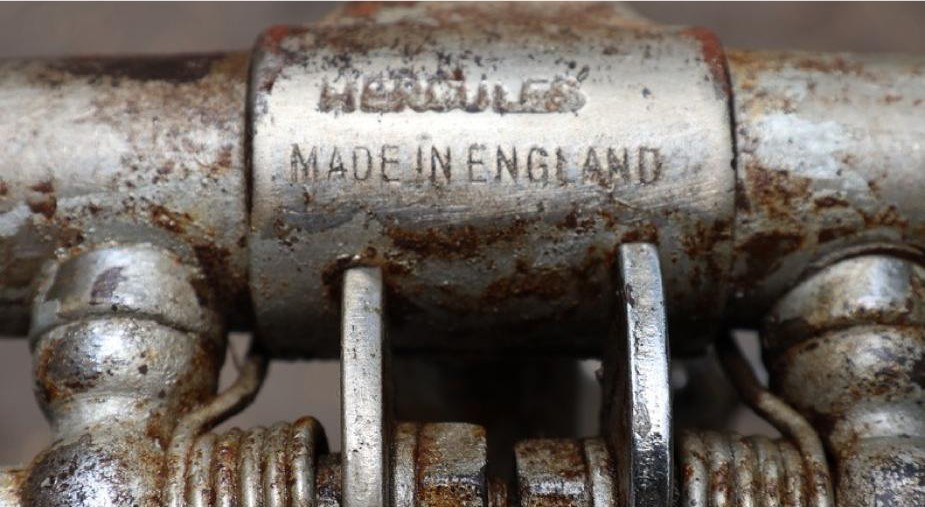
This bicycle, a Hercules - made in England, 24" size, Frame No. KX 15031 - was probably brought to the IIT Madras campus in 1964 by my cousin A. Subramanian when he joined the B. Tech. programme. He graduated in 1969 from the Metallurgical Engineering branch. At that time, he handed over the bicycle to his schoolmate and batchmate from Delhi, S. Palappan of 258, Krishna Hostel.
Subramanian recalls that his father had bought the bicycle in 1946 and used it in New Delhi. Later, it was sent to IIT Madras. I joined IIT Madras as a Senior Technical Assistant on 14 February 1970. I informed my cousin, and he requested his friend Palappan to give the bicycle to me, which he did on 6 May 1970.
When I received the bicycle, it had a side stand and a carrier with a clip for holding books and notebooks. There was no cover for the chain, so my pants often got caught between the chain and the sprocket.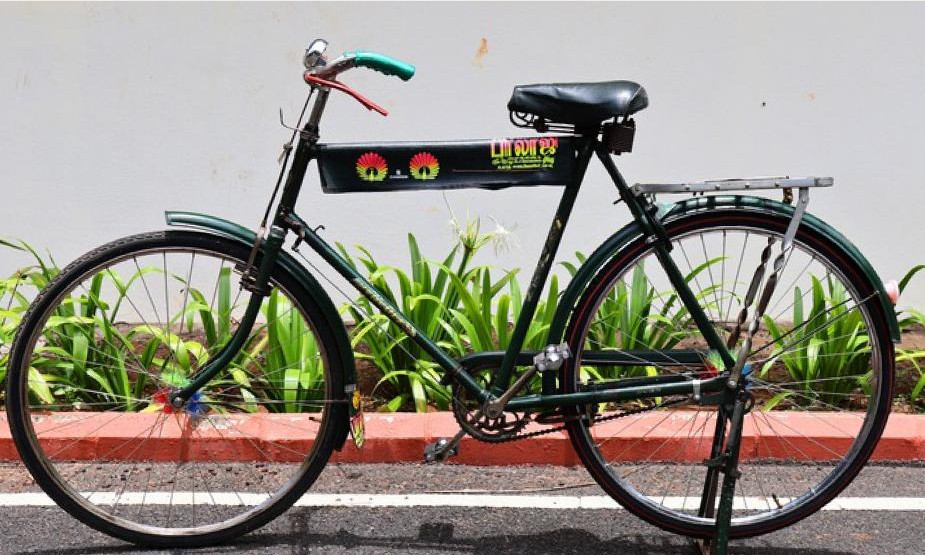
A photograph of the bicycle parked outside the Administration Building in 2026.
To solve this, I added a quarter guard to the chain. The side stand was replaced with a normal stand to provide more stability while parking. When the spring in the carrier's clip failed, I replaced it with a normal carrier, and later changed it back to a carrier with a clip because of its usefulness.
Periodically, the tube and tyre were replaced. Apart from routine maintenance, the bicycle was also given an overhaul on a few occasions. About 20 years ago, I had it repainted and chose green as the colour.
The security section of IIT Madras issued tokens for bicycles on campus. The last such token for this bicycle, given in 1996, was triangular in shape, green in colour, and bore the number 395. One token had to be fixed on the bicycle, while the other was carried by the rider. Both were checked whenever the cycle was taken outside the campus. I used the bicycle not only within the campus but also outside. The farthest I travelled was to the Tamil Nadu Housing Board (TNHB) colony beyond Wimco Nagar, about 25 km from the campus.
On one occasion, while riding doubles from Adyar to the campus with my friend, a lecturer in the Humanities Department, we were stopped by a policeman near the Regional Labour Institute. He wanted to fine us, as double riding was not permitted at the time. We explained that we were heading to IITM to assist the security staff (including policemen) during the ongoing strike by the supporting staff. He let us go without a fine, but only after deflating the tyres.
Another time, I wanted to show the lake, forests, and animals within the campus to my friend's four-year- old son. I seated him on the carrier and pushed the bicycle along. At the end of the trip, I discovered that the thorns that had fallen from the trees had punctured the tubes in multiple places, and the only solution was to replace both tubes.
I remember taking my wife to the OAT for movies, with her seated on the carrier. On one such occasion, I lost balance while taking a turn, and she fell. Needless to say, that was our last doubles ride.
One early morning in 1977, a guest staying with us for a few days urgently needed medicine. I set out for Adyar on my bicycle, but all the medical shops there were closed. I continued further along C. P. Ramasamy lyer Road, and at a junction in Raja Annamalaipuram, I found a pharmacy open and was able to get the required medicine.
In August 1979, there was a severe shortage of water on campus. Water was supplied to the quarters through tankers, and we waited for their arrival. In case of urgent need, we could take our own vessels- kudam, paanai, or drum-and collect water from the pump house. On those days, I used my bicycle by tying two kudams with a rope and placing them on the carrier.
Another time, during a heavy monsoon downpour in Madras, the city was flooded overnight, and bus services were suspended by the Government. My father-in-law, who lived in Shastri Nagar, could not be contacted as the phone lines were down, and there was no power supply. I rode my bicycle through streets filled with knee-deep water, pedalling through muddy pools until I reached his house. Thankfully, I found them safe, even though water surrounded the house, but had not entered inside.
When my sons were born, I added a child seat and a foldable footrest on the bar so I could take them to different places.
Although the bicycle was taller than most standard models, it was comfortable to ride. The cycle shop owner often suggested making alterations to reduce the height, but I refused such proposals. The only difficulty came when I had to dismount suddenly, but I learned to manage those situations.
After my superannuation, I left the campus in December 2011 and moved to Velachery. The frequency of using the bicycle decreased, but I remained deeply attached to it and did not want to dispose of it or give it away.
During a discussion with Kumaran Sathasivam of the Heritage Centre, I asked whether the bicycle could be added as an exhibit in the students' room. He agreed, and I am happy that the bicycle now rests in its rightful place, preserved as part of the campus heritage.
______________________________________________________________________________
Kumaraswamy S. served as a faculty member in the Department of Mechanical Engineering for more than 40 years. His area of expertise is hydroturbomachines. He has also served as the Chief Election Officer for student elections, Warden of Ganga Hostel, and Chairman of the Council of Wardens. He was the first Coordinator of the RuTAG Cell, IIT Madras.