
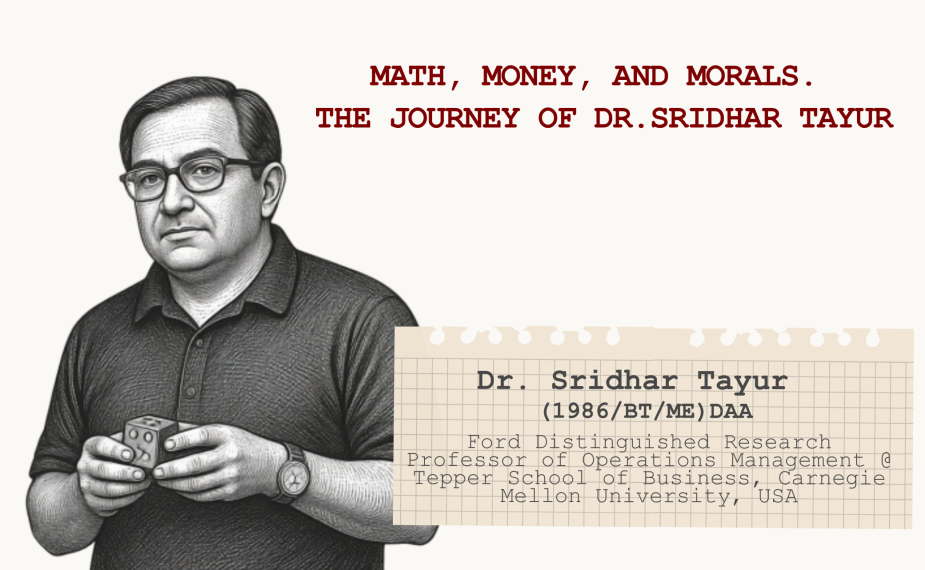
Math, Money, and Morals: The Journey of Dr. Sridhar Tayur
Dr. Sridhar Tayur (1986/BT/ME) DAA, Ford Distinguished Research Chair and University Professor of Operations Management @ Tepper School of Business, Carnegie Mellon University, USA.
On the eve of one of the most important exams of his life, Dr. Sridhar Tayur (1986/BT/ME) DAA made a choice that would seem almost unthinkable to today’s aspirants.
He picked up a cricket bat.
The JEE, arguably the most competitive gateway in the country, was just hours away. Around him, thousands of students were buried in last-minute revision, clinging to formulas and facts in the hope that one final glance might tip the balance. Dr. Sridhar, however, saw things differently.
“Do you think the last four minutes of mugging is going to change anything?” he reflects. “At that point, it is what it is.”
That quiet, almost defiant clarity, the ability to step back, trust his preparation, and refuse to succumb to panic, would become a defining trait. It is the same mindset that would later allow him to walk away from conventional paths, take intellectual risks, and move seamlessly across academia, entrepreneurship, and philanthropy.
At that moment, though, he was just another student writing an exam, without a grand plan for what came next.
An Accidental Beginning at IIT Madras
When Dr. Sridhar secured admission to IIT Madras in 1982, it wasn’t the culmination of a childhood dream. In fact, like many students of his generation, his decision to pursue engineering, and IIT Madras in particular, was shaped more by social expectation than personal conviction.
“Your neighbour’s son gets into IIT Madras, your mother says you should too,” he says, recalling the atmosphere with a hint of humour.
There was no deep fascination with machines, no childhood spent dismantling engines or building models. Mechanical engineering wasn’t a passion; it was simply the branch he was allotted.
“I had no interest in mechanical engineering, or engineering in particular.”
Even the choice of IIT Madras was partly circumstantial. Growing up in Hyderabad, it was geographically convenient, and having been born in Madras added a sense of familiarity. The decision was practical, not aspirational.
Yet, as is often the case with formative experiences, what seemed incidental at the time would later prove transformative.
Life Beyond Classrooms: OAT, Sports, and Serendipity
If academics didn’t define his IIT Madras experience, campus life certainly did.
One of Dr. Sridhar's most vivid memories is of the Open Air Theatre (OAT)
“I think the OAT movie watching, that was fun,” he says.
On weekend nights, students gathered under the open sky, watching English films projected onto a large screen. These weren’t always the latest releases. In fact, in pre-globalization India, films often arrived years after their original release in the West. Sometimes, the selection leaned deliberately toward older classics, films from the 1950s and ’60s.
“We probably saw movies that were made many years before,” he recalls. Those evenings created a shared experience, a pause in the rhythm of academic life, where conversations, laughter, and quiet reflection blended under the night sky.
Beyond OAT, there was sport. Dr. Sridhar played inter-hostel hockey (and Godav was a four-time winner!), occasionally stepped into cricket matches, and even filled in for football teams when they were short of players.
“I wouldn’t say I was deeply committed to any one sport,” he admits. “But I enjoyed being part of it.”
What stands out in his recollection is not intensity, but ease.
“Generally speaking, life was pretty chill.”
It was an environment that allowed room for exploration, not just academically, but intellectually and socially. And it was within this space that something unexpected happened.
A Course That Changed Everything
For a student who had entered IIT Madras without a clear academic passion, the curriculum offered both structure and surprise.
Like all students, Dr. Sridhar had to take electives, some in the humanities. Among them was a course in Indian Writing in English, where he encountered works like Salman Rushdie’s Midnight’s Children, which had just begun to make waves at the time.
But it was another elective, almost incidental in its categorization, that would alter the course of his life.
Operations Research.
“At that time, it was considered a humanities elective,” he says, still amused by the classification.
What he found in that classroom was something he hadn’t encountered before: a discipline that combined mathematical rigor with real-world relevance. It wasn’t just theory; it was application, logic, and problem-solving in action.
“I thought, okay, I actually like something.”
That realization was simple, almost understated. But it marked a turning point.
For the first time, Dr. Sridhar wasn’t just going through the motions. He had found a direction, one that aligned with both his analytical strengths and his curiosity about how systems worked.
At the same time, he remained intellectually open. He explored literature, engaged with ideas beyond engineering, and maintained a broad perspective.
“I was probably open to finding something that would interest me,” he says.
It was this openness, not a rigid plan, that guided his next steps.
Breaking Away: Choosing Cornell Over Convention
By the time Dr. Sridhar approached graduation, the expected trajectory was clear. With strong academic performance, he describes himself as a “10-pointer” with consistently high grades and impressive test scores, and he has had multiple opportunities in traditional mechanical engineering fields.
He had worked on projects in heat transfer, solar refrigeration, and other core areas. Faculty likely assumed he would pursue a PhD in one of these domains.
But Dr. Sridhar wasn’t convinced.
“I didn’t ’t care about CAD/CAM or heat transfer,” he says bluntly. “It’s not that I didn’t understand it, I just didn’t care much for them.”
Instead, he applied to programs in Operations Research, almost as an experiment.
“I just thought, I’ll throw one application there.”
When the admissions offers came in, including one from Cornell University, the choice became clear, not because it was safe, but because it felt right.
The decision puzzled many around him.
“You’re not doing mechanical engineering?” they asked.
But for Dr. Sridhar, the answer was simple.
“I found something I liked. So I followed it.”
Cornell and the Discovery of a Larger World
At Cornell, Dr. Sridhar’s academic journey deepened, but it was also where his worldview expanded dramatically.
His primary focus remained Operations Research, grounded in applied mathematics. But the program required him to take minors, an academic requirement that would prove unexpectedly transformative.
One minor was in stochastic processes and queueing theory, reinforcing his mathematical foundation.
The other was in the Business School.
“That was a culture shock,” he says.
In engineering, precision and correctness dominated. In business school, ambiguity, discussion, and persuasion took center stage. Case studies replaced equations. Arguments were built not just on logic, but on narrative.
“You read a story, and then you argue,” he explains. “And talking persuasively becomes a skill.”
It was in this environment that Dr. Sridhar encountered capitalism, not as an abstract concept, but as a living system.
“I began to understand that the larger game is how money moves,” he says.
This realization didn’t pull him away from academia. Instead, it expanded his understanding of what academia could do.
From Academic Insight to Entrepreneurial Action
By the early 1990s, Dr. Sridhar had positioned himself at a unique intersection, deeply grounded in mathematics, yet increasingly aware of the mechanisms of business and value creation.
Consulting projects with companies like McKinsey and GE gave him a glimpse into real-world applications. A pivotal moment came in 1994, when he met a young entrepreneur named Michael Dell.
Dell was in his 20s, building a computer company that would soon reshape the industry.
“That’s when it crystallized,” Dr. Sridhar says. “Entrepreneurship is the way to create value at scale.”
The idea was not to abandon academia, but to extend it, to take research out of journals and embed it into systems that could operate globally.
This thinking led to the creation of SmartOps, a company that transformed supply chain management through advanced analytics. Over a decade, it grew into a global leader, eventually acquired by SAP, with its technology supporting operations across dozens of countries in hundreds of Global 2000 companies.
For Dr. Sridhar, it was the realization of “practical mathematics”, ideas not just conceived, but deployed at scale.
A Whimsical Idea with Life-Saving Impact
After 20 years immersed in supply chain research and entrepreneurship, Dr. Sridhar was ready for a shift.
“I wanted to do something completely different,” he says.
The idea for OrganJet emerged unexpectedly, during a conversation about organ transplantation logistics.
Instead of transporting organs across long distances, a process fraught with inefficiencies, Dr. Sridhar proposed reversing the model: fly patients to where the organs are.
“It was a simple inversion,” he says.
But its implications were profound.
What began as a spontaneous thought quickly gained traction through medical collaborations, academic interest, and eventually national attention. The initiative improved access to transplants, saved lives, and led to Dr. Sridhar being invited to the White House in 2016.
Ironically, this idea, conceived almost whimsically, captured public imagination in a way his earlier work had not.
“I spent 20 years working hard on the supply chain,” he says with a laugh. “And then this one casual idea gets all the attention.”
A Philosophy That Connects It All
At the heart of Dr. Sridhar’s journey lies a framework he describes as the intersection of math, money, and morals.
Math is the foundation, his discipline, and lens.
Money is the measure, a way to assess value creation.
Morals define the purpose, guiding how that value is used.
“Money is just fuel for the rocket,” he says, recalling a quote from the filmmaker Brad Bird. “What matters is where you want to go.”
This philosophy extends into his philanthropic work, where he supports initiatives in documentary films, South Asian American history, poetry, and beyond, seeking not just to generate wealth but to shape narratives and create lasting social and cultural impact.
A Life of Integration, Not Balance
Today, Dr. Sridhar embodies multiple roles: professor, entrepreneur, investor, and philanthropist.
But he doesn’t see them as separate.
“They’re all the same thing,” he says. “Different manifestations of the same idea.”
His teaching draws from his ventures. His ventures are rooted in academic insight. His philanthropy reflects both.
There is no balancing act, only a continuous, evolving integration.
The Thread That Runs Through It All
If there is a single thread that connects Dr. Sridhar’s journey, from a cricket field before an exam, to OAT movie nights, to global recognition, it is curiosity.
A willingness to explore without a fixed plan.
An openness to discovering what resonates.
And the courage to follow it, even when it defies convention.
“I found Operations Research at IIT Madras,” he says. “That was my turning point.”
For students searching for direction, his advice is simple yet profound:
- Read widely.
- Think deeply.
- Communicate clearly.
- And above all, stay open.
Because sometimes, the most meaningful journeys begin not with certainty, but with curiosity.